Retail Strategy & Visual Merchandising
From Fifth Avenue to the Product Page: How Physical and Digital Merchandising Work Together
Physical storefronts, social content and ecommerce product pages are parts of one customer journey. Here is how retailers connect visual merchandising, inventory, digital campaigns and conversion in 2026.
By Aidan McKnight · Insights
Improve
Book a call →

How this helps: Physical storefronts, social content and ecommerce product pages are parts of one customer journey. Here is how retailers connect visual merchandising, inventory, digital campaigns and conversion in 2026.
TL;DR — Key takeaways
Shoppers move between social, store and phone before buying, so merchandising has to work across all three.
Keep the story consistent but adapt the format: what works in a window rarely works as-is on a product page.
Returns are a real cost of omnichannel selling: NRF and Happy Returns projected $849.9 billion in US returns for 2025, with 19.3% of online sales returned.
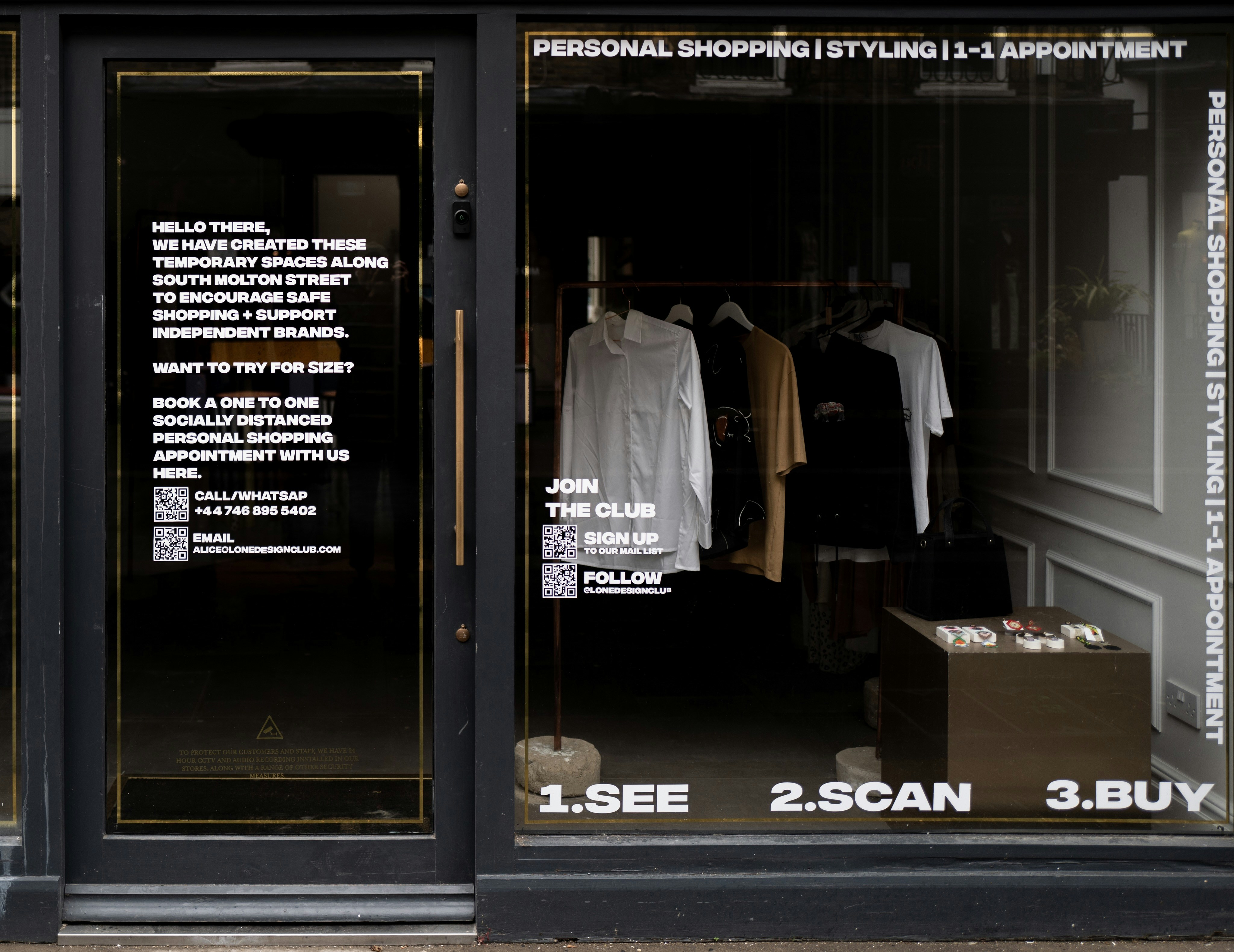
A customer photographs a spectacular Fifth Avenue window, discovers the product on Instagram, compares sizes on a phone, visits the store to see it in person and eventually completes the purchase online. Which channel made the sale? The question is increasingly less useful than understanding how the channels worked together.
Physical and digital merchandising are often managed as separate functions. Store teams think about fixtures, lighting, product placement and foot traffic. Ecommerce teams think about product detail pages, search, recommendations, conversion rates and abandoned carts. Customers do not experience those organizational boundaries. They experience one brand across multiple environments.
The storefront is a discovery channel
Louis Vuitton’s enormous trunk-themed façade on Fifth Avenue illustrates the principle at architectural scale. The installation makes the brand recognizable from a distance, gives pedestrians a reason to stop and creates imagery that can circulate far beyond Manhattan. Its function is not limited to persuading someone standing outside to buy a product immediately. It creates an encounter that may influence a later visit, search or purchase.

Visual overview of this article: four key ideas. Original editorial illustration, not quantitative evidence.
Digital extends the life of physical merchandising
A seasonal window may be installed for weeks, but photographs, videos and editorial coverage can continue circulating after a visitor leaves. Retailers can plan for that from the beginning: create strong visual compositions, make key products identifiable, connect displays to useful online destinations and publish complementary content across owned channels. The physical installation becomes a source of digital creative rather than a one-off expense.
Digital merchandising should continue the story
The digital destination should not feel disconnected from what the customer just saw. If a window highlights a specific collection, the corresponding website or mobile experience should make that collection easy to find. Product photography, descriptions, inventory availability, sizing, delivery and returns information must answer the questions the physical display could not. A visually compelling storefront creates interest; a clear product page makes that interest actionable.
The customer journey is not a straight line
A shopper may first encounter a product in a social video, visit the store to assess quality, leave without purchasing and later order through a mobile website. Another may discover the brand on the street, research reviews at home and return to purchase in person. This is why assigning the entire value of a sale to its final click or last physical visit can misrepresent the role of earlier merchandising touchpoints.
Inventory visibility connects inspiration to availability
One of the most useful bridges between physical and digital merchandising is accurate inventory information. If a shopper sees an item in a window, can they confirm whether their size is available nearby? Can they reserve it, arrange pickup or order delivery? These capabilities turn inspiration into a practical next step. Without reliable product and inventory data, an otherwise elegant omnichannel experience can become a source of frustration.
Visual consistency matters, but identical execution does not
A product presentation designed for a window does not need to be reproduced literally on a phone. The two environments have different constraints. Physical merchandising can use scale, material, lighting and spatial discovery. Digital merchandising can use detail photography, comparison, filtering, recommendations and interaction. The goal is a consistent story adapted to each medium, not a rigid copy of the same layout.
Merchandising and paid media should share the same calendar
Retail campaigns often coordinate inventory, product launches, seasonal creative, promotional offers and advertising budgets. A holiday window that features a collection unavailable online, or a digital campaign promoting products absent from the store, creates unnecessary friction. A shared merchandising calendar can align product availability, creative production, paid media, organic content, email, store operations and fulfillment.
The economics of one connected campaign
Consider a hypothetical retailer that spends $40,000 on a seasonal installation and $20,000 on digital creative and media. Evaluating the window and the online campaign as unrelated expenses may obscure how one supplies attention and content for the other. A more useful analysis considers total incremental contribution from the campaign, including store sales, ecommerce sales and repeat purchasing, against all associated costs. The difficulty is establishing a credible counterfactual: what would customers have done without the campaign?
Measurement should follow customers, not departments
Useful measures include store foot traffic, entries, product interactions, website visits, product-detail engagement, online and in-store conversion, inventory availability, average order value, returns and repeat purchasing. Where appropriate and privacy-respecting, loyalty programs, customer surveys, unique campaign links and controlled geographic or time-based tests can help connect activity across channels. None provides perfect attribution on its own.
Where retailers commonly lose the connection
The problems are usually operational rather than conceptual. Store displays feature products that are difficult to locate online. Paid campaigns use imagery that no longer matches the current assortment. Product data differs across systems. Promotions are inconsistent. Store staff lack visibility into digital offers. Marketing reports reward channel-specific conversions while ignoring the broader customer journey. These are cross-functional coordination failures disguised as merchandising problems.
What smaller businesses can implement
A smaller retailer does not need a flagship on Fifth Avenue to apply the same logic. Start with one seasonal story and make it consistent across the front window, website homepage, product pages, email and social content. Use clear product names and links. Keep stock information accurate. Make in-store pickup or delivery options visible where available. Then evaluate the combined commercial outcome rather than counting impressions in isolation.
Physical experience remains a competitive advantage
Digital commerce excels at convenience, selection and comparison. Physical retail offers tactile inspection, immediate possession, human assistance and a sense of place. The strongest merchandising strategies use those differences deliberately. A beautiful store should give customers something they cannot obtain from a thumbnail. A good website should make it easy to continue the relationship after they leave.
The strategic shift for 2026
The future of merchandising is not simply putting QR codes in windows or adding social-media icons to receipts. It is organizing product, content, inventory, media and measurement around a customer who moves freely between physical and digital environments. Louis Vuitton’s Fifth Avenue trunk demonstrates the attention-generating power of a physical asset. The commercial opportunity begins when that attention connects to a coherent, measurable customer experience.
Further exploration
For a related analysis of the Fifth Avenue installation, read “The Louis Vuitton Trunk on Fifth Avenue: What Holiday Window Merchandising Means in 2026” at The Louis Vuitton Trunk on Fifth Avenue: What Holiday Window Merchandising Means in 2026 . For practical ecommerce diagnostics, explore Store Checkup at /aidanai/ecommerce-helper and Simple Store Checkup at /aidanai/simple-ecommerce-helper .
How to interpret the evidence and recommendations
Evidence: Dates, company disclosures, numerical claims and quotations must be understood in the context of the cited original filing, study or announcement and its publication date.
Interpretation: Comparisons and implications are the author’s judgment. Forecasts and company claims are not independently verified future results.
Recommended next step: Inspect the original source and any later amendments, define the metric and test the business implication before acting.
Research and sources
External research for context and further verification (not evidence for the article’s illustrative scenarios): U.S. Census Bureau, Quarterly Retail E-Commerce Sales (Q2 2026) — https://www.census.gov/retail/eCommerce.html ; NRF, 2025 Retail Returns Landscape — https://nrf.com/research/2025-retail-returns-landscape ; Baymard Institute, Cart & Checkout UX Research — https://baymard.com/research/checkout-usability.
The National Retail Federation and Happy Returns projected $849.9 billion in U.S. retail returns for 2025 and estimated that 19.3% of online sales would be returned. Those figures help explain why returns, store services and fulfillment should be treated as part of merchandising economics rather than afterthoughts. Source: NRF, 2025 Retail Returns Landscape — https://nrf.com/research/2025-retail-returns-landscape .
Continue exploring
Continue the series: The Louis Vuitton Trunk on Fifth Avenue: What Holiday Window Merchandising Means in 2026 ; From Fifth Avenue to the Product Page: How Physical and Digital Merchandising Work Together ; The Decline of Physical Retail Installations: Why Digital Function Matters More Than Storefront Spectacle ; Why the High Street Still Matters: How Digital Strategy Reshapes the Physical Retail Footprint . Test the ecommerce diagnosis at /aidanai/ecommerce-helper .
Book a call
Need help evaluating or implementing the approach for your own business? Discuss a scoped assessment or engagement.
Keep reading
Related articles

Improve
The Louis Vuitton Trunk on Fifth Avenue: What Holiday Window Merchandising Means in 2026
Read article →

Automate
Claude Code Skills vs. OpenAI Codex Skills: What Is Different?
Read article →

Improve
The Decline of Physical Retail Installations: Why Digital Function Matters More Than Storefront Spectacle
Read article →
Want help putting this into practice?
Discuss your next practical step in a short conversation.
Book a Call ↗
